Chapter 7:
In this chapter titled "Organizing and Storing" we learn the best ways to keep our digital photos and physical organized so we may better locate them and preserve them for the future. Every physical photo takes up space. The same is with digital photos. Where they take up space may vary but this is important to keep in mind because we will only be able to preserve and keep as many photos as we have space for. With digital photos there is more information held with them because they store metadata which is the information about the photo itself such as, keywords you choose to tag a photo with, ratings, its file size, the settings that were used when the photo was taken (ISO, aperture, shutter speed, etc.), and the date for when it was taken.It is also important to keep in mind that the more space used digitally, the slower the hardware may run because of how much is stored on it. Similarly, if there are many physical photos stored in a box, the box will become heavier and more difficult to find something specific in as more photos are put into it. What is especially important to realize about digital photos is that they can be lost instantly because of malfunctions with technology, sadly. Because of this, it is important to always back up our photos either on archival DVDs or another form of optical storage disk. A RAID array is a redundant array of inexpensive (or independent) disks which can be accessed through a computer's operating system and allows files to be written to two drivers on a computer at once. Boxes, plastic sleeves, and plastic bags may be most useful for storing physical prints of photos.
Chapter 8:
"Using Light" teaches us how to manipulate light when taking a photograph that will produce a different effect every time the light source is changed, and how lighting affects our photos and how it can change our pictures. What I found most interesting in this chapter were the different positions of lighting and how it can change the way a picture, most notably a portrait, looks. There is frontlighting which is when the light source is close to the lens, high 45 degrees lighting which is when the light source is moved high and to the side of the camera, side lighting which is when the light is at a 90 degree angle to the camera, top lighting which is when the light source is directly above, backlighting which is when the light source is moved to the back of the subject, and then there is is bottom lighting when the lighting comes from below. What I also found interesting in this chapter was that light gets dimmer the further is travels. Using an additional source of light such as a flash can be especially helpful when taking portraits of people and can also produce different effects when positioned differently.
Chapter 9:
In this chapter, "Seeing Like a Camera", we learn about composition and how photographs have a certain type of literacy and grammar to them. Photography is way we keep memories we may not remember and thus can produce emotion and evoke a sense of nostalgia. Everything that you see through the viewfinder in your camera may or may not show up in your photograph. Your viewfinder becomes your eyes. It is important to keep in mind to shoot things that you may like to look at because they will come out nicely after you take the picture. Similarly it is important to think outside of the box and step away from conventional shooting such as shooting an object straight on. Being aware of the background can also help produce a quality picture. Negative and positive space relates to the foreground and the background. It is also important to keep in mind which subjects are in focus in your photo and what you might be trying to say about the subject or your photo in general by keeping something in focus and something not in focus. With photography, you can tell a story. Your photographs can run metaphors that might not otherwise be told or discussed. With any subject it is important to try a variety of ideas such as a different angle position, a different shutter speed, a different ISO, or a different source of lighting. There is a lot of trial and error in photography, and we have to shoot a lot before we can get just the right settings we want to shoot on or the right subject we want to shoot, or even the right part or fragment of the subject we want to shoot. Sometimes it can be discouraging but it is always important to try and even if a photo seems too dark, a little blurry, not sharp enough, or too bright there is always available manipulation after when it comes to editing in digital photography. Luckily, digital photography allows us to erase or keep the artistic choices or mistakes we like or don't like. Even if there is a mistake in a photo that seems unsightly it might be important to keep it there not only for the integrity of the photo but also for the integrity of the narrative that is in a picture.
Chapter 10:
This chapter discusses the history of photography as it is called "History of Photography". "Photography" means to paint with light and was invented in 1839. The first camera was known as the camera obscura or the pinhole camera which was a way of photography that captured a scene by exposing a sheet of film paper to the light of the scene through a small hole. Throughout the ages, photography has expanded from simple "documenting the world to documenting it for a cause". An example of this type of photography can be seen in Dorothea Lange's photograph "Migrant Mother" which is a photo of a mother and two children enduring the treacherous time that was The Depression in the late 1920s to the late 1930s. For me this is the most important aspect of photography. Photography allows people to see the world in the way a photographer might see the world either clearly and literally or not as distinctive and metaphorically. Nonetheless, photography is an art medium that has a voice and is a vehicle for art and experimental art. Photography can go beyond showing what a place, person, or thing looks like but can show an idea or concept that can act as a critique on modern society and the world in which we live.
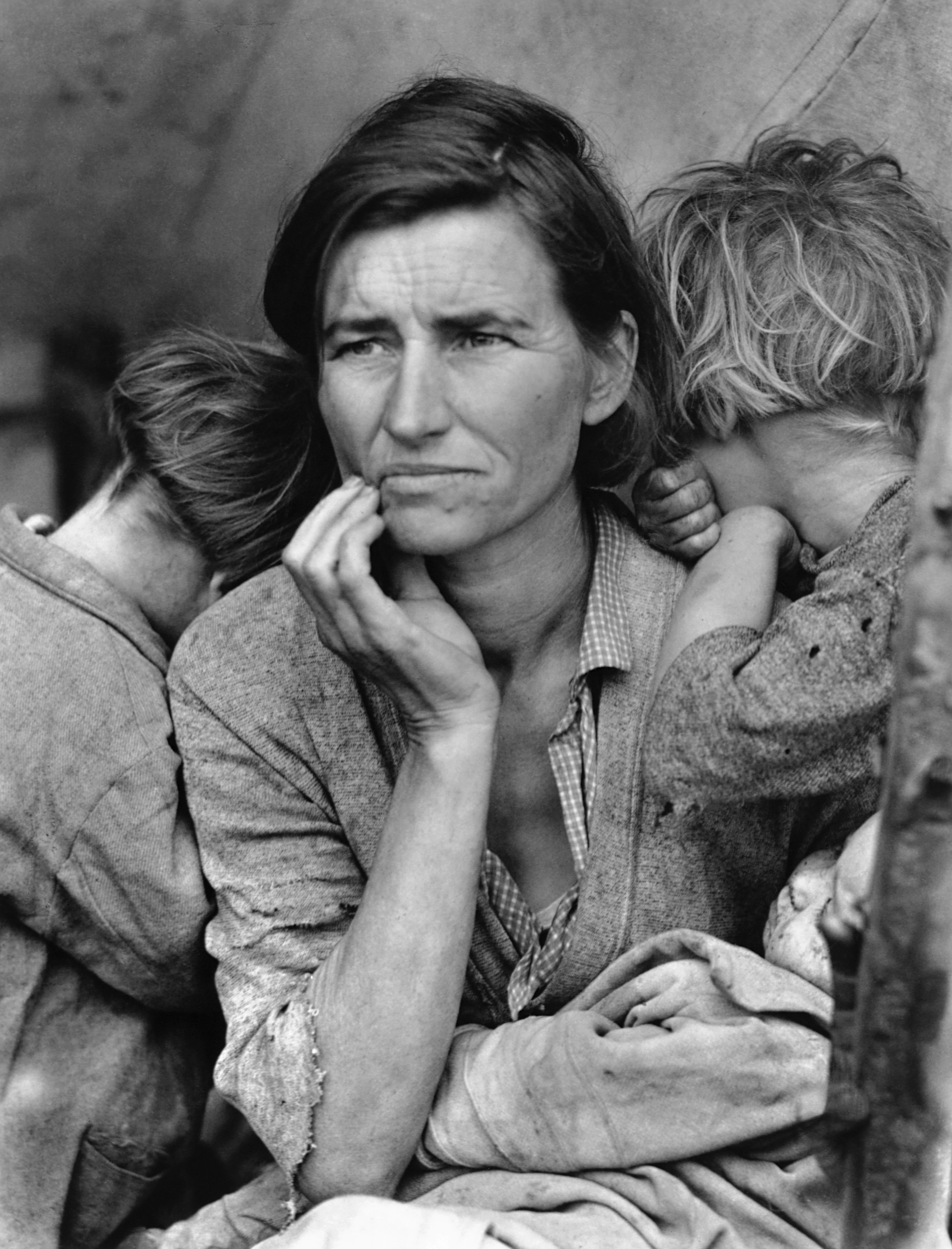 |
| Migrant Mother by Dorothea Lange http://cdn.history.com/sites/2/2014/02/migrant-mother-by-dorothea-lange.jpg |

No comments:
Post a Comment